
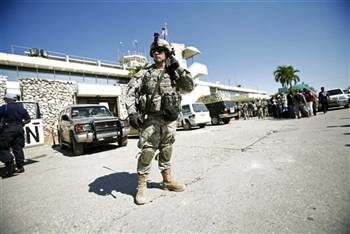
© Ricardo Arduengo / AP
A U.S. Army soldier from the 173rd Company, 73rd Cavalry Division, stands in front of the Toussaint L'ouverture airport in Port-au-Prince
aiti has a longstanding history of US military intervention and occupation going back to the beginning of the 20th Century. US interventionism has contributed to the destruction of Haiti's national economy and the impoverishment of its population.
The devastating earthquake is presented to World public opinion as the sole cause of the country's predicament.
A country has been destroyed, its infrastructure demolished. Its people precipitated into abysmal poverty and despair.
Haiti's history, its colonial past have been erased.
The US military has come to the rescue of an impoverished Nation. What is its Mandate?
Is it a Humanitarian Operation or an Invasion? The main actors in America's "humanitarian operation" are the Department of Defense, the State Department and the U.S. Agency for International Development (USAID). (See
USAID Speeches: On-The-Record Briefing on the Situation in Haiti, 01/13/10). USAID has also been entrusted in channelling food aid to Haiti, which is distributed by the World Food Program. (See
USAID Press Release: USAID to Provide Emergency Food Aid for Haiti Earthquake Victims, January 13, 2010)
The military component of the US mission, however, tends to overshadow the civilian functions of rescuing a desperate and impoverished population. The overall humanitarian operation is not being led by civilian governmental agencies such as FEMA or USAID, but by the Pentagon.
The dominant decision making role has been entrusted to US Southern Command (SOUTHCOM).
A massive deployment of military hardware personnel is contemplated. The Chairman of the Joint Chiefs of Staff Admiral Mike Mullen has confirmed that the US will be sending nine to ten thousand troops to Haiti, including 2000 marines. (
American Forces Press Service, January 14, 2010)
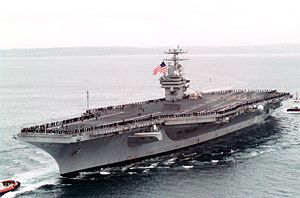
Aircraft carrier, USS
Carl Vinson and its complement of supporting ships has already arrived in Port au Prince. (January 15, 2010). The 2,000-member Marine Amphibious Unit as well as and soldiers from the U.S. Army's 82nd Airborne division "are trained in a wide variety of missions including security and riot-control in addition to humanitarian tasks."
In contrast to rescue and relief teams dispatched by various civilian teams and organizations, the humanitarian mandate of the US military is not clearly defined:
"Marines are definitely warriors first, and that is what the world knows the Marines for,... [but] we're equally as compassionate when we need to be, and this is a role that we'd like to show -- that compassionate warrior, reaching out with a helping hand for those who need it. We are very excited about this." (Marines' Spokesman, Marines Embark on Haiti Response Mission, Army Forces Press Services, January 14, 2010)
While presidents Obama and Préval spoke on the phone, there were no reports of negotiations between the two governments regarding the entry and deployment of US troops on Haitian soil. The decision was taken and imposed unilaterally by Washington.
The total lack of a functioning government in Haiti was used to legitimize, on humanitarian grounds, the sending in of a powerful military force, which has de facto taken over several governmental functions. Table 1US Military Assets to be Sent to Haiti. (according to official announcements)The amphibious assault ship USS Bataan (LHD 5) and amphibious dock landing ships USS
Fort McHenry (LSD 43) and USS
Carter Hall (LSD 50).
A 2,000-member Marine Amphibious Unit from the
22nd Marine Expeditionary Unit and soldiers from the
U.S. Army's 82nd Airborne division. 900 soldiers are slated to arrive in Haiti by January 15th.
Aircraft carrier, USS
Carl Vinson and its complement of supporting ships. (arrived in Port au Prince on January 15, 2010):
USS Carl Vinson CVN 70The
hospital ship USNS Comfort Several U.S. Coast Guard vessels and helicopters

© Unknown
USS Carl Vinson
The three amphibious ships will join aircraft carrier USS
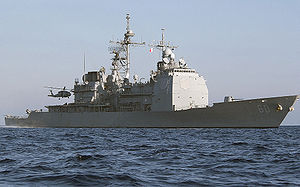
Carl Vinson, guided-missile cruiser
USS Normandy and
guided-missile frigate USS Underwood. 
© Unknown
USS Normandy
US Southern Command (SOUTHCOM) with headquarters in Miami is the "lead agency" in Haiti. Its mandate as a regional military command is to carry out modern warfare. Its stated mission in Latin America and the Caribbean is "to conduct military operations and promote security cooperation to achieve U.S. strategic objectives." (
Our Mission - U.S. Southern Command (USSOUTHCOM) The commanding officers are trained to oversee theater operations, military policing as well "counterinsurgency" in Latin America and the Caribbean, including the recent establishment of new US military bases in Colombia, within proximity of the Venezuelan border.
General Douglas Fraser, commander of U.S. Southern Command has defined the Haiti emergency operation as a Command, Control, Communications operation (C3). US Southern Command is to oversee a massive deployment of military hardware, including several warships, an aircraft carrier, airborne combat divisions, etc:
"So we're focused on getting command and control and communications there so that we can really get a better understanding of what's going on. MINUSTAH [United Nations Stabilization Mission in Haiti], as their headquarters partially collapsed, lost a lot of their communication, and so we're looking to robust that communication, also.
We're also sending in assessment teams in conjunction with USAID, supporting their efforts, as well as putting in some of our own to support their efforts.
We're moving various ships that we had in the region -- they're small ships, Coast Guard cutters, destroyers -- in that direction, to provide whatever immediate assistance that we can on the ground.
We also have a U.S. Navy aircraft carrier, the USS Carl Vinson, moving in that direction. It was at sea off of Norfolk, and so it's going to take a couple of days for it to get there. We need to also just resupply it and give it the provisions it needs to support the effort as we look at Haiti. And then we're looking across the international agencies to figure out how we support their efforts as well as our efforts.
We also are looking at a large-deck amphibious ship with an embarked Marine Expeditionary Unit on it that will be a couple of days behind the USS Vinson.
And that gives us a broader range of capability to move supplies around, to have lift capability to help support the effort there also.
So bottom line to it is, we don't have a clear assessment right now of what the situation on the ground is, what the needs within Port-au-Prince are, how extensive the situation is.
We also, finally, have a team that's headed in to the airport. From my understanding -- because my deputy commander just happened to be in Haiti when this situation happened, on a previously scheduled visit. He has been to the airport. He says the runway is functional but the tower doesn't have communications capability. The passenger terminal -- has structural damage to it, so we don't know what the status of it is.
So we have a group going in to make sure we can gain and secure the airfield and operate from it, because that's one of those locations we think we're going to have a lot of the immediate effort from an international basis going into.
And then we're out conducting all the other assessments that you would consider appropriate as we go in and work this effort.
We're also coordinating on the ground with MINUSTAH, with the folks who are there. The commander for MINUSTAH happened to be in Miami when this situation happened, so he's right now traveling back through and should be arriving in Port-au-Prince any time now. So that will help us coordinate our efforts there also, because again, obviously the United Nations suffered a significant loss there with the collapse -- at least partial collapse of their headquarters.
So that's -- those are the initial efforts that we have ongoing And as we get the assessments of what's coming next, then we'll adjust as required.
The secretary of Defense, the president, have all stipulated that this is a significant effort, and we're corralling all the resources within the Department of Defense to support this effort." (Defense.gov News Transcript: DOD News Briefing with Gen. Fraser from the Pentagon, January 13, 2010)
A Heritage Foundation report summarizes the substance of America's mission in Haiti:
"The earthquake has both humanitarian and U.S. national security implications [requiring] a rapid response that is not only bold but decisive, mobilizing U.S. military, governmental, and civilian capabilities for both a short-term rescue and relief effort and a longer-term recovery and reform program in Haiti." (
James M. Roberts and Ray Walser, American Leadership Necessary to Assist Haiti After Devastating Earthquake, Heritage Foundation, January 14, 2010).
At the outset, the military mission will be involved in first aid and emergency as well as public security and police activities.
US Air Force Controls the AirportThe US Air Force has taken over air traffic control functions as well as the management of Port au Prince airport. In other words, the US military regulates the flow of emergency aid and relief supplies which are being brought into the country in civilian planes. The US Air Force is not working under the instructions of Haitian Airport officials. These officials have been displaced. The airport is run by the US Military (Interview with Haitian Ambassador to the US R. Joseph, PBS News, January 15, 2010)
"The FAA's team is working with DOD combat controllers to improve the flow of air traffic moving in and out of the airport. The US Air Force reopened the airport on 14 January, and on 15 January its contingency response group was granted senior airfield authority ... Senior airfield authority enables the Air Force to
prioritise, schedule and control the airspace at the airport, ..." (
flightglobal.com, January 16, 2010, emphasis added)
The 1,000-bed U.S. Navy hospital ship, USNS Comfort, which includes more than 1,000 medical and support personnel has been sent to Haiti under the jurisdiction of Southern Command. (See
Navy hospital ship with 1,000 beds readies for Haiti quake relief, Digital Journal, January 14, 2010). There were, at the time of the Earthquake, some 7100 military personnel and over 2000 police, namely a foreign force of over 9000. In contrast, the international civilian personnel of MINUSTAH is less than 500.
MINUSTAH Facts and Figures - United Nations Stabilization Mission in HaitiTable 2United Nations Stabilization Mission in Haiti (MINUSTAH)Current strength (30 November 2009)
9,065 total uniformed personnel
7,031 troops
2,034 police 488 international civilian personnel
1,212 local civilian staff
214 United Nations Volunteers
MINUSTAH Facts and Figures - United Nations Stabilization Mission in Haiti Estimated combined SOUTHCOM and MINUSTAH forces; 19,095* *Excluding commitments by France (unconfirmed) and Canada (confirmed 800 troops). The US, France and Canada were "partners" in the February 29, 2004 Coup d'État.
Haiti has been under foreign military occupation since the US instigated February 2004 Coup d'Etat. The contingent of US forces under SOUTHCOM combined with those of MINUSTAH brings foreign military presence in Haiti to close to 20,000 in a country of 9 million people. In comparison in Afghanistan, prior to Obama's military surge, combined US and NATO forces were of the order of 70,000 for a population of 28 million.
In other words, on a per capita basis there will be more troops in Haiti than in Afghanistan.Recent US Military Interventions in HaitiThere have been several US sponsored military interventions in recent history. In 1994, following three years of military rule, a force of 20,000 occupation troops and "peace-keepers" was sent to Haiti. The 1994 US military intervention "was not intended to restore democracy. Quite the contrary: it was carried out to prevent a popular insurrection against the military Junta and its neoliberal cohorts." (Michel Chossudovsky,
The Destabilization of Haiti, Global Research, February 28, 2004)
US and allied troops remained in the country until 1999. The Haitian armed forces were disbanded and the US State Department hired a mercenary company DynCorp to provide "technical advice" in restructuring the Haitian National Police (HNP). (Ibid).
The February 2004 Coup d'ÉtatIn the months leading up to the 2004 Coup d'Etat, US special forces and the CIA were training death squadrons composed of the former tonton macoute of the Duvalier era. The Rebel paramilitary army crossed the border from the Dominican Republic in early February 2004. "It was a well armed, trained and equipped paramilitary unit integrated by former members of
Le Front pour l'avancement et le progrès d'Haiti (FRAPH), the "plain clothes" death squadrons, involved in mass killings of civilians and political assassinations during
the CIA sponsored 1991 military coup, which led to the overthrow of the democratically elected government of President Jean Bertrand Aristide." (see Michel Chossudovsky,
The Destabilization of Haiti: Global Research. February 28, 2004)
Foreign troops were sent into Haiti. MINUSTAH was set up in the wake of the US sponsored coup d'Etat in February 2004 and the kidnapping and deportation of the democratically elected president Jean Bertrand Aristide.
The coup was instigated by the US with the support of France and Canada. The FRAPH units subsequently integrated the country's police force, which was under the supervision of MINUSTAH. In the political and social disarray triggered by the earthquake, the former armed militia and Ton Ton macoute will be playing a new role.
Hidden AgendaThe unspoken mission of US Southern Command (SOUTHCOM) with headquarters in Miami and US military installations throughout Latin America is to ensure the maintenance of subservient national regimes, namely US proxy governments, committed to the Washington Consensus and the neoliberal policy agenda. While US military personnel will at the outset be actively involved in emergency and disaster relief,
this renewed US military presence in Haiti will be used to establish a foothold in the country as well pursue America's strategic and geopolitical objectives in the Caribbean basin, which are largely directed against Cuba and Venezuela. The objective is not to work towards the rehabilitation of the national government, the presidency, the parliament, all of which has been decimated by the earthquake. Since the fall of the Duvalier dictatorship, America's design has been to gradually dismantle the Haitian State, restore colonial patterns and obstruct the functioning of a democratic government. In the present context, the objective is not only to do away with the government but also to revamp the mandate of the United Nations Stabilization Mission in Haiti (MINUSTAH), of which the headquarters have been destroyed.
"The role of heading the relief effort and managing the crisis quickly fell to the United States, for lack -- in the short term, at least -- of any other capable entity." ( US Takes Charge in Haiti _ With Troops, Rescue Aid - NYTimes.com, January 14, 2009)
Prior to the earthquake, there were, according to US military sources, some 60 US military personnel in Haiti.
From one day to the next, an outright military surge has occurred: 10,000 troops, marines, special forces, intelligence operatives, etc., not to mention private mercenary forces on contract to the Pentagon. In all likelihood the humanitarian operation will be used as a pretext and justification to establish a more permanent US military presence in Haiti.
We are dealing with a massive deployment, a "surge" of military personnel assigned to emergency relief.
The first mission of SOUTHCOM will be to take control of what remains of the country's communications, transport and energy infrastructure. Already, the airport is under de facto US control. In all likelihood, the activities of MINUSTAH which from the outset in 2004 have served US foreign policy interests, will be coordinated with those of SOUTHCOM, namely the UN mission will be put under de facto control of the US military.
The Militarization of Civil Society Relief OrganizationsThe US military in Haiti seeks to oversee the activities of approved humanitarian organizations. It also purports to encroach upon the humanitarian activities of Venezuela and Cuba:
"The government under President René Préval is weak and literally now in shambles. Cuba and Venezuela, already intent on minimizing U.S. influence in the region, are likely to seize this opportunity to raise their profile and influence..." (James M. Roberts and Ray Walser, American Leadership Necessary to Assist Haiti After Devastating Earthquake, Heritage Foundation, January 14, 2010).
In the US, the militarization of emergency relief operations was instigated during the Katrina crisis, when the US military was called in to play a lead role.
The model of emergency intervention for SOUTHCOM is patterned on the role of NORTHCOM, which was granted a mandate as "the lead agency" in US domestic emergency procedures.
During Hurricane Rita in 2005, the detailed groundwork for the "militarization of emergency relief" involving a leading role for NORTHCOM was established. In this regard, Bush had hinted to the central role of the military in emergency relief: "Is there a natural disaster--of a certain size--that would then enable the Defense Department to become the lead agency in coordinating and leading the response effort? That's going to be a very important consideration for Congress to think about." (Statement of President Bush at a press conference,
Bush Urges Shift in Relief Responsibilities - washingtonpost.com, September 26, 2005).
"The response to the national disaster is not being coordinated by the civilian government out of Texas, but from a remote location and in accordance with military criteria. US Northern Command Headquarters will directly control the movement of military personnel and hardware in the Gulf of Mexico. As in the case of Katrina, it will override the actions of civilian bodies. Yet in this case, the entire operation is under the jurisdiction of the military rather than under that of FEMA." (Michel Chossudovsky, US Northern Command and Hurricane Rita, Global Research, September 24, 2005)
Concluding RemarksHaiti is a country under military occupation since the US instigated Coup d'Etat of February 2004.
The entry of ten thousand heavily armed US troops, coupled with the activities of local militia could potentially precipitate the country into social chaos.
These foreign forces have entered the country to reinforce MINUSTAH "peacekeepers" and Haitian police forces (integrated by former Tonton Macoute), which since 2004, have been responsible for war crimes directed against the Haitian people,
including the indiscriminate killing of civilians. These troups reinforce the existing occupation forces under UN mandate.
Twenty thousand foreign troops under SOUTHCOM and MINUSTAH commands will be present in the country. In all likelihood, there will be an integration or coordination of the command structures of SOUTHCOM and MINUSTAH.
The Haitian people have exhibited a high degree of solidarity, courage and social commitment.
Helping one another and acting with consciousness: under very difficult conditions, in the immediate wake of the disaster, citizens rescue teams were set up spontaneously.
The militarization of relief operations will weaken the organizational capabilities of Haitians to rebuild and reinstate the institutions of civilian government which have been destroyed. It will also encroach upon the efforts of the international medical teams and civilian relief organisations.
It is absolutely essential that the Haitian people continue to forcefully oppose the presence of foreign troops in their country, particularly in public security operations.
It is essential that Americans across the land forcefully oppose the decision of the Obama adminstration to send US combat troops to Haiti.
There can be no real reconstruction or development under foreign military occupation.




 Posts
Posts

